
E-commerce · AI Support 70% faster first response

AI Support Ticket & Helpdesk Automation System

A growing e-commerce brand was drowning in support tickets across email, chat, Slack, and their web portal. I built an AI-powered helpdesk that categorizes, routes, and drafts replies — with human approval before anything goes out. First-response time dropped up to 70%.
The Challenge

The client came to me after a support backlog that would not shrink. Ticket volume had crossed 1,200 per month and was still climbing. Customers reached them through email, live chat, a web portal, Slack, and phone messages logged by the team — five channels, five different inboxes, no single place to see what was urgent.

Their small support team was doing the same work on repeat: password resets, order status checks, refund requests, shipping delays. Agents copied answers from a shared doc, retyped customer details into their helpdesk, and manually decided who should handle each ticket. After-hours messages sat until morning. Escalations happened in Slack threads that never made it back to the ticket record.

They had Gorgias for ticket management but were barely using automation — mostly because earlier Zapier-style rules broke on edge cases and nobody trusted auto-replies going out without review. The ops lead said it plainly: "We need AI to do the boring parts, but we cannot afford to send wrong answers to paying customers."

The goal was not a chatbot demo. It was a production system: ingest tickets from every channel, understand intent, draft accurate replies, route to the right person, and keep a human in the loop on anything that touches money, refunds, or policy.

The Solution

We scoped this in two phases so the team could trust it before turning anything fully automatic.

Phase 1 — Unified intake and smart routing
Every channel feeds one queue. Email, chat, Slack, and portal submissions normalize into a single ticket model with source metadata preserved. A classification layer tags intent — refund, shipping, billing, product question, escalation — and priority based on keywords, customer tier, and SLA rules. High-priority tickets surface immediately; repetitive low-risk tickets get flagged for AI handling.

Phase 2 — AI drafting with human-in-the-loop approval
For common intents, the system generates a draft reply trained on the client's help docs, past resolved tickets, and refund/shipping policies. Nothing sends automatically. Agents see the ticket, the AI-suggested response, confidence score, and recommended action — then Approve, Edit & approve, Reject, or Mark handoff.

Sensitive actions stay blocked until a human signs off. Refund offers, Shopify order changes, and account modifications require explicit approval — the UI makes that obvious so there is no accidental automation of live commerce actions.

Phase 3 — Escalation, analytics, and 24/7 coverage
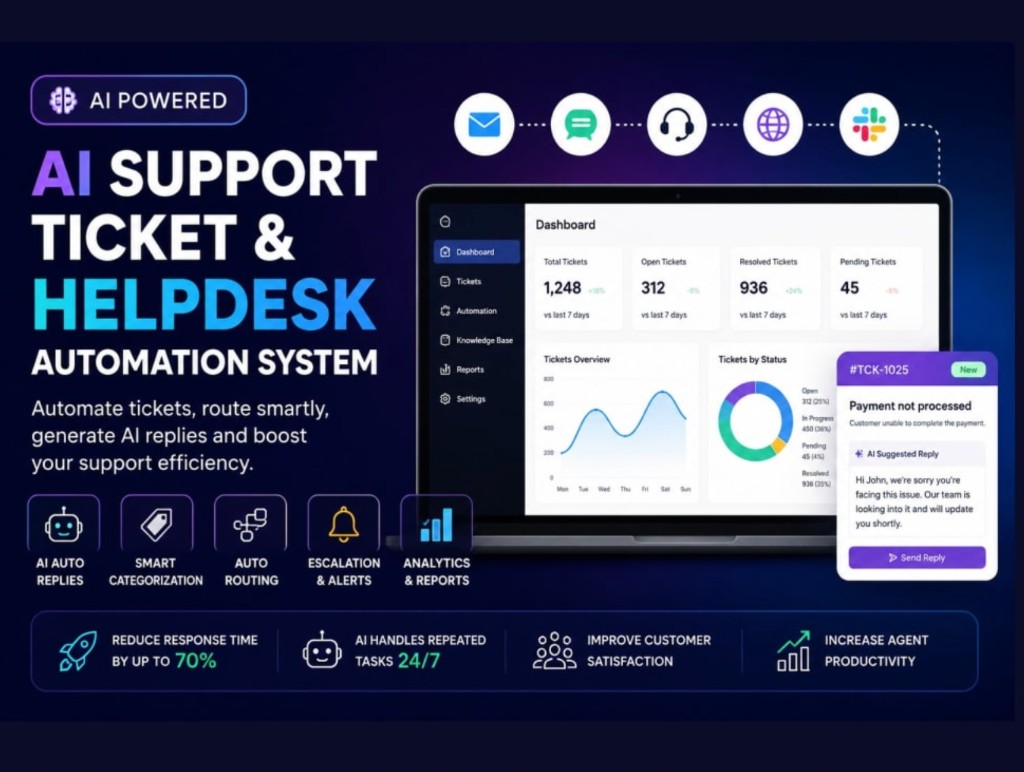
Escalation rules notify the right person on Slack when a ticket stalls, when confidence is low, or when a customer asks for a manager. The analytics dashboard tracks total volume, open vs resolved trends, status breakdown, and channel mix — so leadership can see whether automation is actually helping or just shuffling work.

I built the agent dashboard, classification pipeline, Gorgias sync, and approval workflow as one cohesive product rather than a chain of brittle integrations. The team got Loom walkthroughs, runbooks for edge cases, and a tuning period where we reviewed rejected drafts and improved the training set weekly.

The Results

Within the first six weeks after go-live, median first-response time on AI-eligible tickets dropped by roughly 70% compared to the prior month baseline.

The dashboard showed the shift clearly: resolved ticket volume up 24% week-over-week while open backlog fell 8% — not because they hired more agents, but because repetitive tickets stopped waiting for a human to copy-paste the same answer.

Roughly 65% of incoming tickets now get an AI draft on first pass. Agents spend their time reviewing and approving instead of writing from scratch. After-hours coverage improved because FAQs and order-status questions get drafted overnight; a human approves in the morning batch rather than starting cold at 9am.

Escalations are cleaner too — when the AI marks handoff, the full transcript and suggested next step travel with the ticket. The ops lead told me the team "finally feels like support is a system, not a fire drill."

This is still human-in-the-loop by design. About one in five drafts gets edited before send. That is a feature, not a failure — it means the AI handles volume while people stay accountable for customer trust.

Project snapshot

  • Industry: E-commerce · DTC brand (support-led operations)
  • Scope: Multi-channel helpdesk, AI categorization, auto-routing, draft replies, human approval UI, analytics
  • Integrations: Gorgias, Slack, email, live chat, web portal
  • Timeline: ~8 weeks from discovery to production rollout
  • Stack: Python, OpenAI API, PostgreSQL, React dashboard, webhook intake, Gorgias API

Inside the support agent dashboard

The agent view is built for speed: ticket queue on the left, full context in the center, AI draft review on the right. Filters for Needs review, Draft ready, Handoff, Approved, and High priority let the team work in batches instead of scrolling one inbox.

AI support agent dashboard with ticket queue, intent detection, and human approval workflow
Agent dashboard — AI drafts replies; humans approve before anything is sent to customers.

What the system handles automatically

  • AI auto-replies — drafts policy-aligned responses for refunds, shipping, billing, and product FAQs
  • Smart categorization — tags intent and priority so urgent tickets do not sit behind password resets
  • Auto routing — assigns tickets by category, channel, and agent availability
  • Escalation & alerts — Slack notifications when SLAs slip or confidence is low
  • Analytics & reports — volume trends, status breakdown, and channel mix for leadership

Why human-in-the-loop mattered

This client sells physical products with real refund and shipping policies. A wrong auto-reply is not a minor bug — it is a chargeback or a lost customer. Every sensitive workflow blocks live actions until a person approves. That constraint shaped the architecture from day one and is why the team adopted it faster than their previous automation attempts.

If your support queue is growing faster than your headcount — and you want AI that assists agents instead of replacing judgment — book a call and we can map what a first production version looks like in week one.

Share

Want similar results for your business?

Get Free Project Estimate
Free MVP Plan Book Call Instant Hire